

Shoulder Care and Surgery in Duluth, MN
The hip is one of the largest weight-bearing joints in the body and one of the most relied upon for everyday movement. While it is built to handle repeated motion over time, hip pain from arthritis, labral tears, fractures, and joint degeneration is among the most common reasons patients seek orthopaedic care.
At Orthopaedic Associates of Duluth, our hip specialists provide surgical and non-surgical care across the full range of hip conditions. Our board-certified surgeons work alongside physician assistants, physical therapists, and occupational therapists, so your evaluation, treatment, and rehabilitation are managed together by the same team.

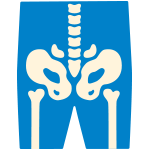

Hip Conditions and Injuries We Treat
Hip problems range from acute fractures and sports-related labral injuries to chronic arthritis that develops gradually and limits daily movement. Our physicians evaluate each patient individually and recommend a treatment path based on the diagnosis, the extent of the condition, and what the patient needs to return to doing.
- Broken Hip
- Hip Arthritis
- Hip Labral Tear
- Hip Pain
- Total Hip Replacement
- Direct Anterior Hip Replacement
- Revisions, Hip
- Hip Fracture Surgery
- Hip Arthroscopy
- Non-operative Treatments
Hip Treatment Options at Orthopaedic Associates
Hip Arthroscopy and Labrum Repair
Minimally invasive procedures performed through small incisions to diagnose and treat problems inside the hip joint. Used for labral tears, FAI correction, cartilage damage, and hip impingement. Our surgeons also perform hip arthroscopy for joint preservation in younger or active patients. This includes labral reconstruction and/or augmentation based on each individual patient’s needs.
Hip Fracture Surgery
Surgical repair for hip fractures including femoral neck and femur fractures, as well as periprosthetic fracture care for patients with prior hip replacement. Prompt evaluation and treatment are important for hip fracture patients, and same-day orthopaedic consultations are available.
Total Hip Replacement
Surgical replacement of a damaged hip joint with a prosthetic implant for patients with severe arthritis or joint degeneration that has not responded to non-surgical treatment. Both traditional posterior and direct anterior approaches are available. Robotic-assisted techniques are also offered by select surgeons on our team.
Revision Hip Replacement
Surgical revision of a prior hip replacement for patients experiencing pain, implant loosening, infection, or mechanical failure. Dr. Landon Brown is fellowship trained in Adult Total Joint Reconstruction and provides complex and revision hip replacement care.
Non-Surgical Treatment
Physical therapy, activity modification, and ultrasound-guided hip injections for patients whose condition is appropriate for non-operative management. Dr. Heather Grothe performs ultrasound-guided hip injections and holds RMSK certification with AIUM accreditation in musculoskeletal ultrasound.

Total Hip Replacement in Duluth, MN
Indications
The primary indication for a total hip arthroplasty is to relieve pain caused by severe arthritis when non-operative treatment has not provided adequate relief. Destruction of articular cartilage can limit your ability to walk, climb stairs, and perform daily activities. When arthritis progresses and joint inflammation causes significant joint breakdown, pain may limit movement and contribute to muscle weakness and stiffness over time. Your surgeon will evaluate whether total hip replacement is the appropriate next step based on your imaging, examination, and history with prior treatment.
Total Hip Arthroplasty Surgery
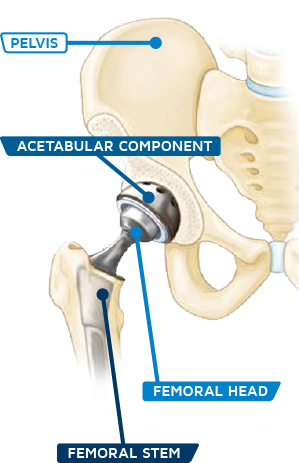
The hip is a ball and socket joint. The socket is a cup-shaped bone on the pelvis, and the ball is the head of the femur. During surgery, the surgeon removes the damaged femoral head and replaces it with a prosthesis consisting of a metal or ceramic ball attached to a metal stem. The stem is fitted into a canal made in the femur bone. A metal alloy socket with a polyurethane (plastic) liner is placed into the pelvis to replace the damaged socket. Procedure length varies by patient and complexity. Your surgeon will walk you through what to expect before the operation.
Recovery
Recovery after total hip replacement varies by patient based on prior activity level, overall health, and how the body responds to surgery. Most patients progress from a walker to a cane as strength and stability improve, though the timeline is different for each person.
Following surgery, most patients are referred to physical therapy, either in-home or at our outpatient clinic. Your therapist will evaluate your function, strength, and range of motion and develop a program around your specific recovery goals. Swelling around the hip and knee is common and can persist for several months. Bruising around the hip and down the leg is also normal, may appear a few days after surgery, and resolves with time. Your care team will guide you on what to expect at each stage of recovery.
Direct Anterior Hip Replacement in Duluth, MN
The direct anterior approach to hip replacement accesses the hip joint through the front of the hip rather than the side or back. Because the approach works between muscle groups rather than detaching them, it does not require the surgeon to cut through the muscles surrounding the hip joint.
The short-term recovery profile for many patients differs from a traditional posterior approach. Patients who have the direct anterior procedure often progress more quickly in the early weeks of recovery and typically have fewer movement restrictions in that period. The long-term results of the anterior approach are generally comparable to those of the traditional posterior approach.
Not every patient is a candidate for the direct anterior approach. Certain factors, including a patient’s anatomy and bone structure, affect whether this technique is appropriate. Your surgeon will evaluate which approach is the right fit for your specific situation during your consultation.
Physicians performing direct anterior hip replacement at Orthopaedic Associates: Dr. Patrick G. Hall, Dr. Samuel Harms, Dr. Joshua Rother and Dr. Michael C. Momont. Dr. Landon D. Brown performs both anterior and posterior approach total hip replacement.
Robotic-Assisted Hip Replacement in Duluth, MN
Robotic-assisted hip replacement is available at Orthopaedic Associates for appropriate candidates. Robotic assistance allows the surgeon to plan the procedure in detail before the operation and execute that plan with precision during surgery, with the implant positioning tailored to each patient’s anatomy.
Physicians performing robotic-assisted hip replacement at Orthopaedic Associates: Dr. Michael C. Momont and Dr. Landon D. Brown.
Your surgeon will discuss during your consultation whether robotic-assisted hip replacement is appropriate for your situation.
Common Questions About Hip Replacement
Generally, yes. The long-term clinical results of the direct anterior approach are comparable to those of the traditional posterior approach. The primary differences are in the early recovery period, where some patients experience a quicker progression with the anterior approach and have fewer post-surgical movement restrictions.
Not every patient is a suitable candidate. Certain anatomical factors, including bone structure and body type, affect whether the anterior approach can be used safely and effectively. The decision about which surgical approach is right for you is made in consultation with your surgeon based on your imaging and individual anatomy.
Procedure length varies by patient, surgical approach, and the complexity of the case. Your surgeon will give you a more precise estimate during your pre-operative consultation.
Recovery timelines vary considerably based on the type of procedure, the patient’s pre-surgical health and activity level, and how the body responds. Your physical therapist and surgeon will set realistic expectations for your specific situation and adjust your plan as recovery progresses.
Meet Our Hip Specialists in Duluth, MN

Samuel P. Harms, MD
Meet the Doctor: Samuel P. Harms, MD
Patrick G. Hall, MD
Meet the Doctor: Patrick G. Hall, MD
Joshua J. Rother, MD
Meet the Doctor: Joshua J. Rother, MD
Michael C. Momont, MD
Meet the Doctor: Michael C. Momont, MD
Glen H. Rudolph, MD
Meet the Doctor: Glen H. Rudolph, MD
Heather L. Grothe, MD
Meet the Doctor: Heather L. Grothe, MD
Phillip L. Thomas, M.D.
Meet the Doctor: Phillip L. Thomas, M.D.
Landon D. Brown, MD
Meet the Doctor: Landon D. Brown, MD
Schedule with a Hip Specialist in Duluth, MN
Our hip specialists see patients at our Duluth clinic and at locations across Northern Minnesota including Hibbing, Rock Ridge/Virginia, Grand Rapids, International Falls, and Ely. Same-day appointments are often available for acute hip injuries and fractures.
Call to schedule, or use our contact form.